
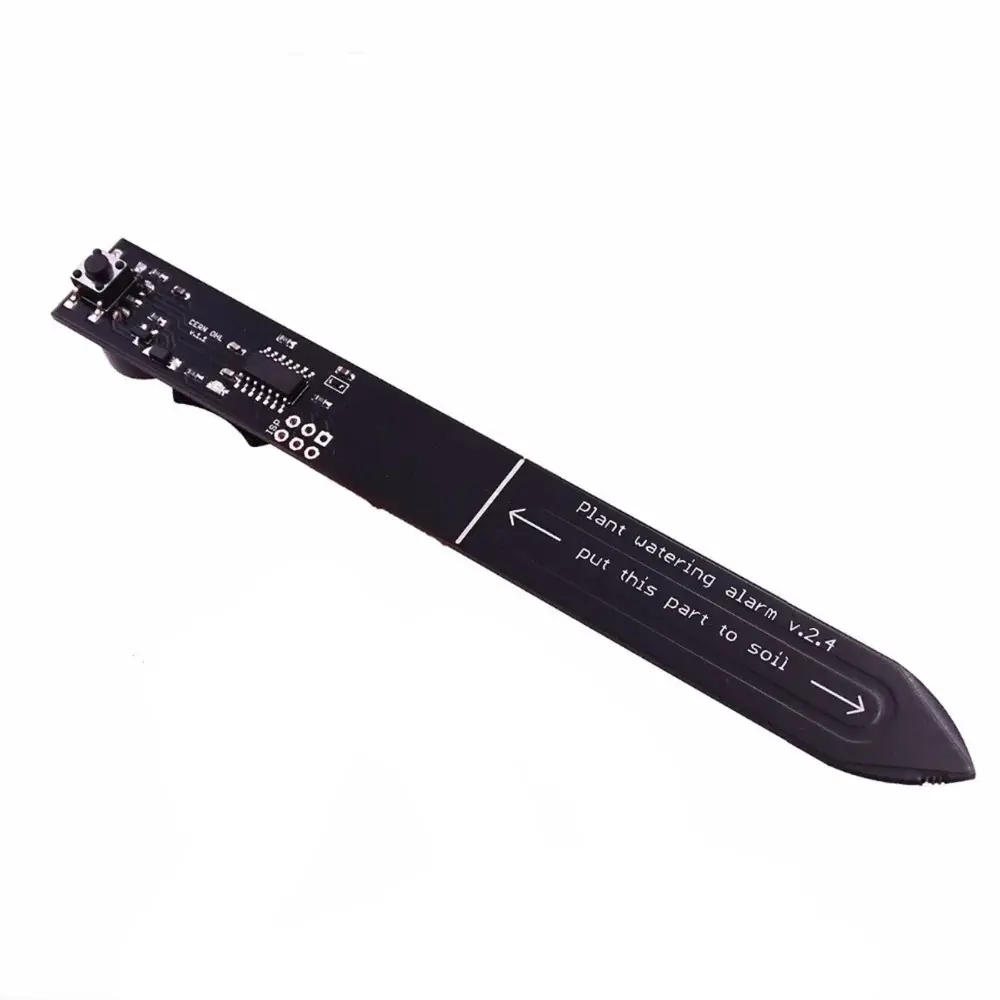

Soil Moisture Sensor Plant Watering Alarm A
Overview
A Soil Moisture Sensor Plant Watering Alarm is a device designed to:
Measure soil water content (moisture level)
Detect dry or wet soil conditions
Trigger an alert (LED, buzzer, or digital signal) when watering is required
It is commonly used as a threshold-based moisture monitoring and alert system, not a precision soil analysis instrument.
Working Principle
There are two main sensing methods, depending on design:
1. Resistive Soil Moisture Sensing (Most Common)
Principle:
Two conductive probes are inserted into soil
Soil moisture affects electrical conductivity
Behavior:
Wet soil low resistance (more conductive)
The sensor measures resistance and converts it into a voltage signal.
2. Capacitive Soil Moisture Sensing (Advanced Type)
Principle:
Measures dielectric constant of soil
Water increases dielectric constant changes capacitance
More stable and resistant to corrosion than resistive type.
Output Types
Analog Output
Continuous voltage proportional to moisture level
Used for:
Monitoring trends
Precise threshold control
Digital Output (Alarm Function)
Comparator compares moisture level with preset threshold
Output triggers:
HIGH or LOW signal
LED or buzzer activation
This forms the watering alert/p>
Moisture sensing probes
Signal conditioning circuit
Comparator (e.g., LM393)
Adjustable potentiometer (threshold setting)
Output stage (LED / buzzer / digital pin)
Electrical Characteristics
Operating voltage: 3.3V to 5V (typical)
Low current consumption
TTL-compatible outputs
Functional Operation
Step-by-step:
Sensor probes detect soil moisture
Signal converted to voltage
Comparator checks against threshold
If soil is dry:
Alarm triggers (LED/buzzer ON)
If soil is wet:
Alarm OFF
Environmental Behavior
Sensitivity Factors
Soil type (clay, sand, loam)
Temperature
Response
Fast response to moisture changes
Stability depends on sensor type:
Capacitive more stable
Resistive more noise and drift
Limitations
Resistive Type
Corrosion of probes over time (due to electrolysis)
Readings affected by:
Soil salinity
Mineral content
General Limitations
Measures relative moisture, not exact volumetric water content
Requires calibration for different soil types
Not suitable for scientific-grade measurements
Operating Behavior
Threshold-Based Alert
User sets moisture level
Sensor triggers alarm when below threshold
Analog output allows real-time tracking
Practical Characteristics
Simple and low-cost sensing method
Works best in:
Garden soil
Indoor plant monitoring
Performance depends on:
Proper probe placement
Consistent soil conditions
System Role
This sensor acts as a:
Moisture level detector
Dry soil alert generator
Input device for irrigation control systems
Summary
The Soil Moisture Sensor Plant Watering Alarm is a basic environmental sensing and alert system that:
Detects soil moisture using resistive or capacitive methods
Provides analog and/or digital
Triggers alerts when soil becomes dry
Operates on simple comparator-based logic
Is optimized for plant care and basic irrigation monitoring