
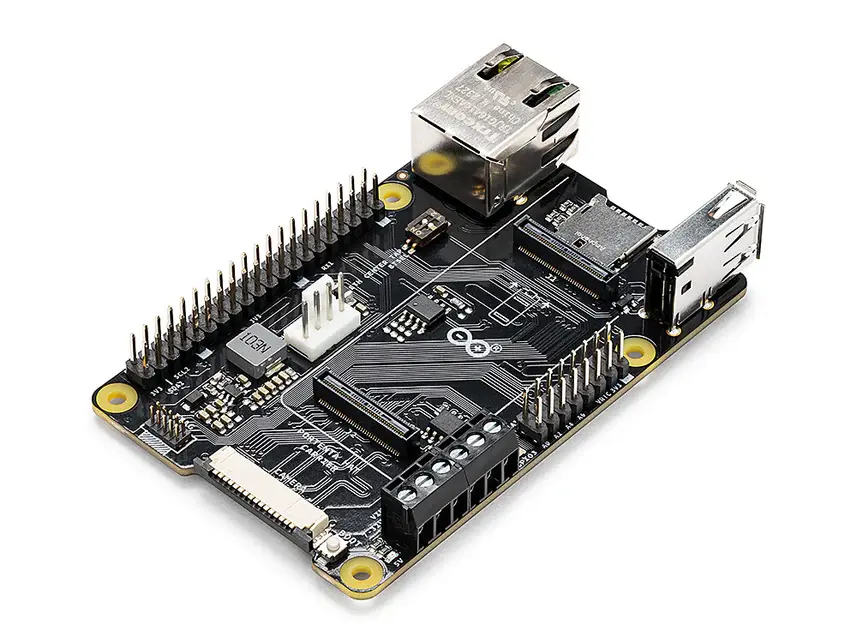

Arduino Portenta Hat Carrier Development Board – ASX00049
Arduino Portenta Hat Carrier (ASX00049) – a development board for compatible Portenta modules.
What It Is
The Portenta Hat Carrier is a robust development board that transforms compatible Arduino Portenta boards (like Portenta X8, Portenta H7, or Portenta C33) into industrial'style computing platforms. It bridges the Arduino ecosystem with Raspberry Pi HATs, cameras, sensors, and industrial interfaces making it ideal for advanced embedded projects, automation, machine vision, and scalable IoT systems.
Infographic'Style Summary
ARDUINO PORTENTA HAT CARRIER | | Development Board | | (SKU: ASX00049) | Purpose | Industrial & Advanced Prototyping Compatible Boards | Portenta X8, Portenta H7, Portenta C33 | Raspberry Pi Header | 40pin GPIO compatible with HATs | Network Connectivity | Gigabit Ethernet (X8) / 100Mbps (H7/port | MIPI CSI camera connector | Industrial I/O | CAN FD transceiver, 16 analog I/Os | Debug Support | On'board JTAG connector | Thermal Control | PWM fan connector | Temp Range | 40C to +85C |
Key Features & Capabilities
Industrial'Grade Connectivity
Ethernet port: Up to Gigabit with Portenta X8 for high'speed wired networking. 100Mbps with Portenta H7/C33.
USB'A port: Plug in keyboards, storage, cameras, or other USB peripherals.
microSD card slot: Local storage useful for data logging, media, or OS images.
Raspberry Pi HAT Compatibility
A sta boards) directly drastically expanding hardware options.
Industrial & Sensor Interfaces
CAN FD with onboard transceiver for automotive/industrial communications.
16 extra analog/digital I/Os for sensors, actuators, or control signals.
UART, SPI, I2C, PWM, and more accessible via headers.
Camera & Vision
A MIPI CSI camera connector enables integration with machine vision sensors great for automation, robotics, or smart monitoring.
Development & Debugging
Onboard 10pin JTAG connector simplifies firmware debugging.
PWM fan port helps maintain thermal performance during heavy processing tasks.
These tools make prototyping and deb/p>
Power & Operating Conditions
Flexible power options: From Portenta's USB'C. From the 40pin header (5V). From a screw terminal block (732V DC) powering both the carrier and attached Portenta board.
Wide temperature range: 40C to +85C suitable for industrial environments.
Typical Use Cases
This carrier board is ideal for projects where you need high performance, broad connectivity, and expandability:
Industrial automation & sensing systems Robotics controllers with external sensors and cameras Machine vision platforms scalable embedded IoT gateways High'speeduino's real'time MCU capabilities with industrial interfaces, Pi'compatible expansion, and networking, this carrier lets engineers and developers move from simple microcontroller sketches to full'featured embedded computing platforms all within the Arduino ecosystem.
Tech Snapshots
Feature | Detail |
Compatibility | Portenta X8 / H7 / C33 |
Network | Gigabit / 100Mbps Ethernet |
USB | USB'A Host |
Storage | microSD card |
Industrial I/O | CAN FD, analog, PWM, UART, SPI, I2C |
Camera | MIPI CSI connector |
Debug | Onboard JTAG |
Power | 732V / USB'C / 5V header |