
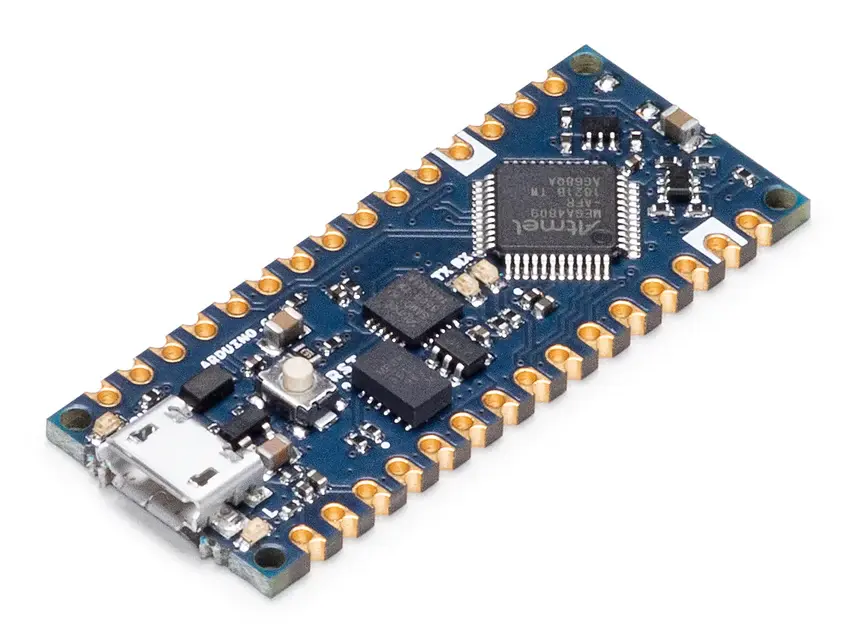

Arduino Nano Every – ABX00028
Arduino Nano Every (ABX00028) – a compact Arduino Nano-format microcontroller board.
| ARDUINO NANO EVERY (ABX00028) |+----------------------------+-------------------------------------+| Microcontroller | ATmega4809 AVR (8-bit) ||----------------------------|-------------------------------------|| Operating Voltage | 5 V Logic ||----------------------------|-------------------------------------|| Clock Speed | 20 MHz ||----------------------------|-------------------------------------|| Memory 48 KB Flash ||----------------------------|-------------------------------------|| RAM | 6 KB SRAM ||----------------------------|-------------------------------------|| EEPROM | 256 bytes ||----------------------------|-------------------------------------|| Digital I/O Pins | 14 Pins (incl. 5 PWM capable) ||----------------------------|-------------------------------------|| Analog Inputs | 8 10-bit ADC &bsp; ||----------------------------|-------------------------------------|| Communication Interfaces| UART, SPI, I2C ||----------------------------|-------------------------------------|| PWM Outputs | 5 (D3, D5, D6, D9, D10) ||----------------------------|-------------------------------------|| Power Input | USB / VIN 721 V ||----------------------------|-------------------------------------|| On-board LED | Pin 13 LED (built-in) ||----------------------------|-------------------------------------|| Size & Weight &nbs |++
What Makes It Different
More Power Than Classic Nano
The ATmega4809 microcontroller gives the Nano Every ~50 % more flash memory than the Arduino Uno and ~200 % more RAM, allowing larger sketches and more complex logic.
I/O & VIN power input up to 21 V flexible powering options for external supplies.
Memory & Performance
Feature | Detail |
Flash Memory | 48 KB for sketch & libraries |
SRAM | 6 KB for runtime data |
EEPROM | 256 bytes for persistent settings |
CPU Clock | 20 MHz for responsive performance |
(All specs based on official datasheet info for the Nano Every.) |
Power & Connectivity
Operating Voltage: 5 V logic compatible with most classic Arduino designs.
Power Input: from USB or VIN 721 V for flexible deployment in projects.
USB Interface: uses ATSAMD11D14A as a USB-to-serial converter for programming/debugging and could be repurposed by advanced users.
Size & Form Factor
Compact footprint: ~45 mm 18 mm breadboard-friendly and small enough for tight embedded builds.
Weight: ~5 g lightweight for wearable or robotics projects.
Typical Use Cases
Wearables & compact electronics fits in small enclosures easily. Low-cost robotics sensor control and motor interfacing. Interactive prototypes responsive I/O with PWM control. Educational projects ideal for learning microcontroller basics.
Development & Support
Fully supported in the Arduino IDE with the megaAArduino libraries and community examples. Easy USB upload and debugging simplifies development.
Why It Matters
The Arduino Nano Every delivers more flash and RAM than earlier Nano boards while keeping the classic small form factor and 5 V compatibility giving makers, students, and engineers a cost-effective, capable microcontroller for a wide range of classic