
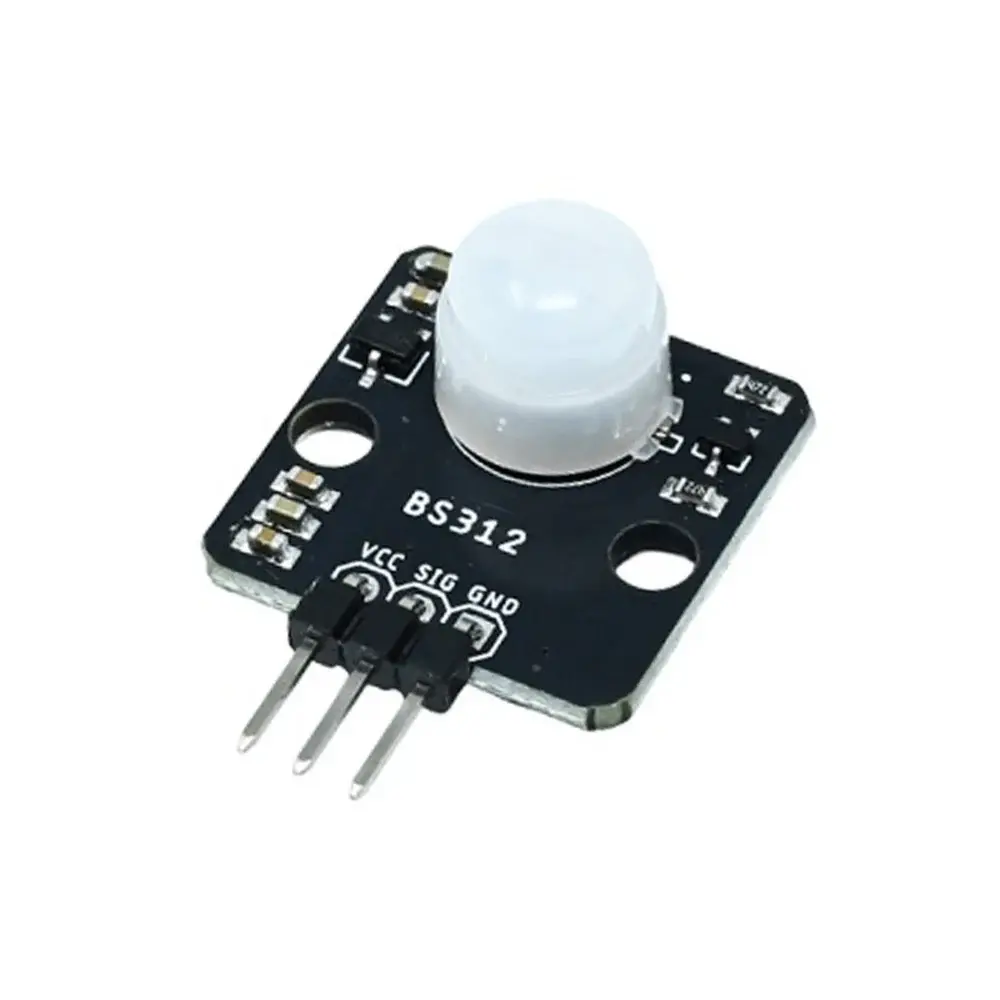

SmartElex BS312 PIR Motion Sensor
Overview
The BS312 is a low-power passive infrared (PIR) motion sensor designed to detect human movement by sensing changes in infrared radiation emitted by warm bodies. It integrates sensing, signal processing, and output circuitry into a compact unit.
Working Principle
Uses a pyroelectric infrared sensing element to detect variations in IR radiation.
When a human body moves across the sensor's field, the IR level changes.
An internal analog-to-digital conversion (ADC) and control circuit processes this signal.
Output is converted into a digital HIGH/LOW signal for motion detection.
Internal Architecture
Pyroelectric sensing element
Integrated signal conditioning circuit
On-chip ADC and digital processing
Electromagnetic shielding enclosure (reduces noise/interference)
edli>Operating voltage: 2.2 V to 3.7 V
Static current consumption: < 12 A (very low power) Designed for battery-powered systems due to ultra-low standby current
Detection Characteristics
Sensing range: up to 12 meters (with proper Fresnel lens)
Detection angle: ~120 (horizontal field of view)
Sensing window size: 3 4 mm
Output Characteristics
Type: Digital output
Signal levels:
HIGH Motion detected
LOW No motion
Direct interface with digital systems without analog processing
Functional Behavior
Detects dynamic changes in infrared radiation (movement), not static presence
Best response when motion is across the fensor
Processing is handled internally, so no external filtering required
Physical Characteristics
Compact size (~28 20 11 mm)
Small sensing window suitable for integration into embedded devices
Key Technical Features
Fully integrated PIR + digital processing
Ultra-low power consumption
Wide-angle detection
Medium-to-long detection distance
Noise-resistant design (shielded housing)
Simple digital interface
Limitations (Important Technical Points)
Cannot detect stationary objects (only motion-based IR change)
Performance depends on:
Ambient temperature
Lens quality and placement
Speed and direction of movement
Sensitive to sudden environmental IR changes (h