
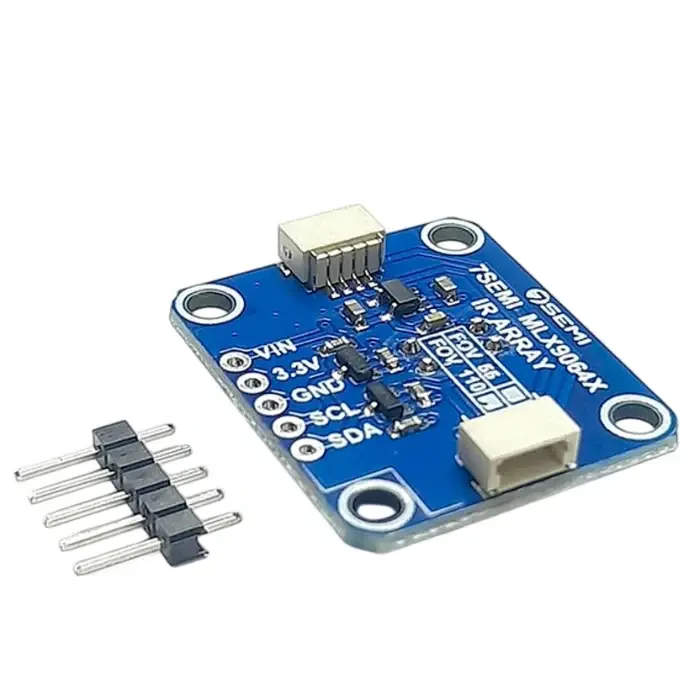

MLX90640 IR Thermal Camera Breakout 110° FOV I2C Interface - 7Semi
=======================================================
MLX90640 IR THERMAL CAMERA BREAKOUT
(110° Wide‑Angle FOV, I2C Interface – 7Semi)
=======================================================

MODEL: MLX90640 IR Thermal Camera Breakout
SENSOR TYPE: Melexis MLX90640 far‑infrared thermal array
RESOLUTION: 32 × 24 pixels (768 temperature points) :contentReference[oaicite:1]{index=1}
FOV (Field of View): 110° × 75° wide angle :contentReference[oaicite:2]{index=2}
INTERFACE: Digital I²C (address default 0x33) :contentReference[oaicite:3]{index=3}
SUPPLY VOLTAGE: 3.3 V (with 5 V compatible breakout) :contentReference[oaicite:4]{index=4}
CURRENT: < 23 mA typical :contentReference[oaicite:5]{index=5}
REFRESH RATE: Configurable, ~0.5 Hz → 64 Hz :contentReference[oaicite:6]{index=6}
NOISE SENSITIVITY: NETD ~ 0.1 K RMS @ 1 Hz :contentReference[oaicite:7]{index=7}
OPERATING TEMP: −40 °C → +85 °C :contentReference[oaicite:8]{index=8}
MEASURABLE TARGET: −40 °C → +300 °C :contentReference[oaicite:9]{index=9}

-------------------------------------------------------
📌 WHAT IT IS:
A compact **thermal imaging module** that captures
infrared temperature data over a 110° wide scene.
Each pixel reports temperature, so you get a heat
map rather than a single point measurement. :contentReference[oaicite:10]{index=10}

-------------------------------------------------------
📊 HOW IT WORKS:
• The MLX90640 contains a **32×24 infrared sensor grid**. :contentReference[oaicite:11]{index=11}
• Each pixel measures IR radiation from the environment. :contentReference[oaicite:12]{index=12}
• The sensor outputs digital temperature values over **I2C**. :contentReference[oaicite:13]{index=13}
• Host microcontroller reads the array and builds a heat map.

-------------------------------------------------------
🔌 ELECTRICAL INTERFACE:
• **VCC** → 3.3 V supply (5 V tolerant input) :contentReference[oaicite:14]{index=14}
• **GND** → Ground :contentReference[oaicite:15]{index=15}
• **SDA** → I2C data :contentReference[oaicite:16]{index=16}
• **SCL** → I2C clock :contentReference[oaicite:17]{index=17}

*I2C address is usually 0x33.* :contentReference[oaicite:18]{index=18}

-------------------------------------------------------
📈 KEY PERFORMANCE POINTS:
• **Wide capture area:** 110° FOV covers large thermal scenes. :contentReference[oaicite:19]{index=19}
• **768 thermal pixels:** good resolution for general thermal patterns. :contentReference[oaicite:20]{index=20}
• **Low power:** < 23 mA typical current. :contentReference[oaicite:21]{index=21}
• **Configurable frame rate:** adjust for speed vs. power. :contentReference[oaicite:22]{index=22}
• **Factory calibrated:** no user recalibration needed. :contentReference[oaicite:23]{index=23}

-------------------------------------------------------
📌 INSTALLATION & USAGE NOTES:
• Use a host with enough RAM (e.g., **ESP32, Raspberry Pi, STM32**). :contentReference[oaicite:24]{index=24}
• I²C bus should be stable — avoid excessive noise. :contentReference[oaicite:25]{index=25}
• Higher refresh rates need faster controllers. :contentReference[oaicite:26]{index=26}

-------------------------------------------------------
🔧 COMMON APPLICATIONS:
• Thermal imaging and temperature mapping :contentReference[oaicite:27]{index=27}
• Human/animal presence detection :contentReference[oaicite:28]{index=28}
• HVAC and insulation inspection :contentReference[oaicite:29]{index=29}
• Industrial monitoring & safety controls :contentReference[oaicite:30]{index=30}
• Robotics & IoT environmental sensing :contentReference[oaicite:31]{index=31}
