
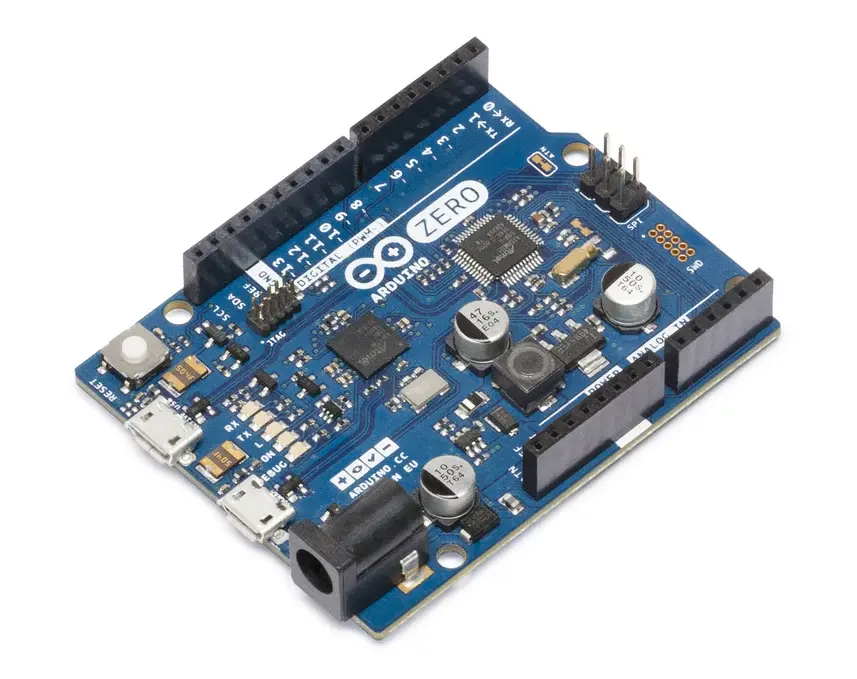

Arduino Zero Micro-Controller Board - ABX00003
What It Is
The Arduino Zero is a 32bit microcontroller board built around a 32bit ARM Cortex'M0+ core more powerful and capable than classic 8bit Arduino Uno'class boards. It is designed for real'time control, advanced embedded applications, IoT systems, sensor fusion, and educational learning of ARM'level programming.
Infographic'Style Summary
ARDUINO ZERO MICRO'CONTROLLER | | BOARD (ABX00003) | + MCU | ATSAMD21G18 (32bit ARM Cortex'M0+) | Clock Speed | 48 MHz | Flash Memory | 256 KB | SRAM | 32 KB | Digital I/O Pins | 20 | PWM Outputs | 10 | Analog Inputs | 6 12bit ADC | Analog Output | 1 st) | Operating Voltage | 3.3V logic (max) | Tools | Arduino IDE / SWD Debug (EDBG)
The logic and I/O operate at 3.3V, so driving 5V signals without level shifting can damage the board.
Detailed Features
High'Performance ARM Cortex'M0+ CPU
Powered by the ATSAMD21G18, this board uses a 32bit ARM Cortex'M0+ processor running at 48MHz, enabling more efficient data handling, faster code execution, and richer peripherals compared with older 8bit boards.
This makes it ideal for:
IoT devices and connected sensors
Wearable tech
Real'time control systems
Automation & robotics projects
torage
256KB Flash enough space for larger sketches 32KB SRAM fast, real'time data No EEPROM use Flash or external storage for persistent data
Rich I/O & Peripheral Support
20 digital input/output pins (many become PWM outputs)
10 PWM outputs for motor controls, dimming LEDs, etc
6 analog inputs with 12bit resolution
1 analog output (10bit DAC) for audio, actuators, etc.
Plus serial protocols like UART, SPI, and I2C make it easy to connect displays, sensors, wireless modules, and more.
Native USB & Onboard Debugger
One of the Ze provides:
USB'based serial communication Debugging via SWD (no external debugger needed) Virtual COM port support program and monitor without extra hardware
This makes development easier for complex programs and educational use.
Typical Applications
The Zero is versatile and suited for:
IoT sensor hubs and cloud'connected devices Wearable or embedded tech with precise timing and data throughput Custom robotics control systems Real'time audio or signal processing (with enough code optimization) Educational development of modern ARM'based firmware
Programming & Software
You can program the Arduino Zero using the standard Arduino IDE, with built'in Atmel Studio / Microchip Studio using EDBG.
Quick Tech Specs
Why It Matters
The Arduino Zero ABX00003 is a bridge from classic 8bit Arduino to modern 32bit embedded development. It offers ming without greatly increasing complexity for beginners and advanced users alike. It's great for serious projects, learning ARM programming, IoT prototypes, and real'time control
Feature | Detail |
Processor | 32bit ARM Cortex'M0+ (ATSAMD21G18) |
Clock Speed | 48MHz |
I/O | 20 digital, 10 PWM capable |
Analog Inputs | 6 (12bit) |
Analog Output | 1 (10bit DAC) |
Flash | 256KB |
SRAM | 32KB |
USB | Micro'USB (native + debug) |
Voltage | 3.3V I/O |
Debug | Onboard EDBG |